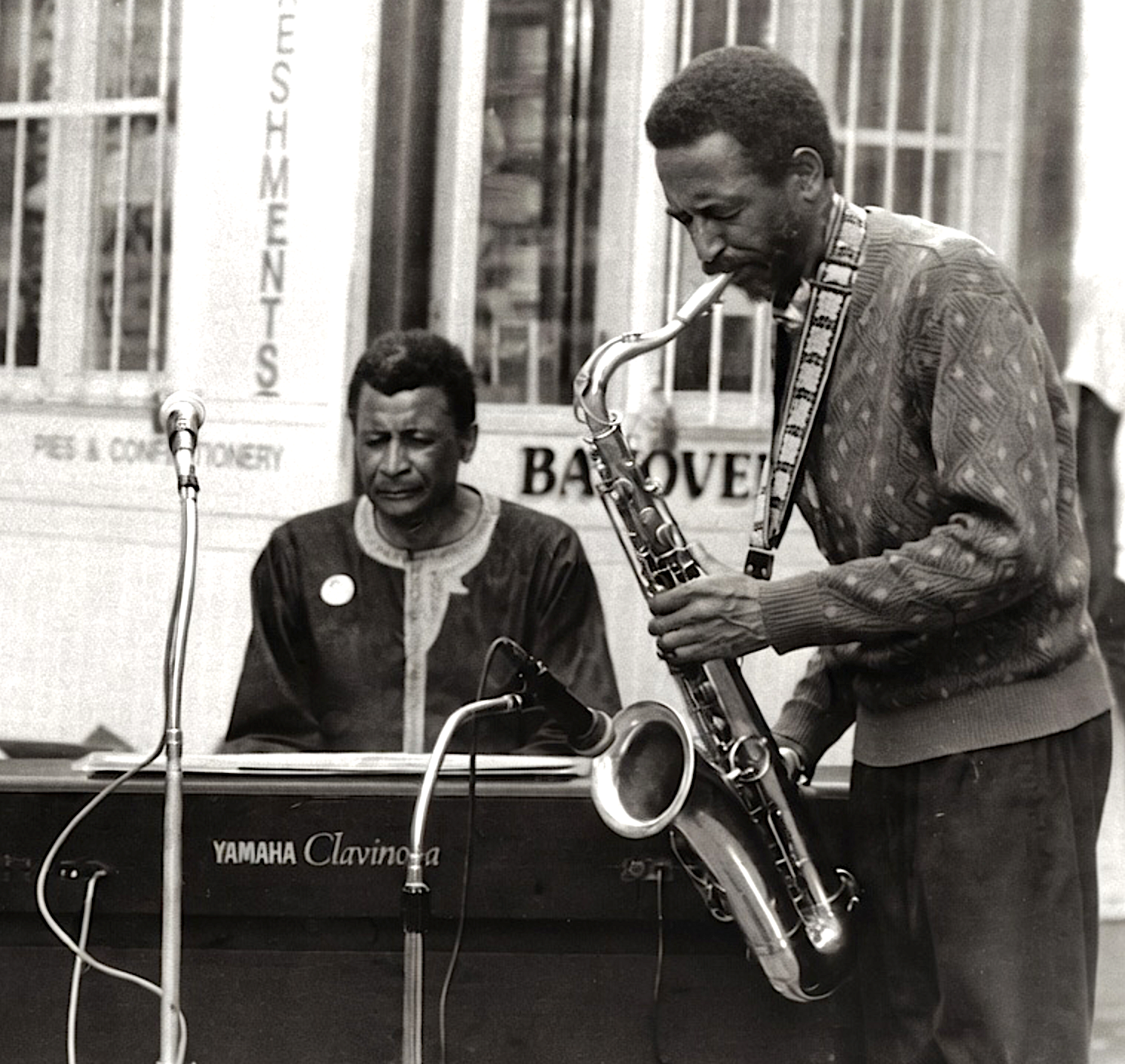
A rare picture of Abdullah Ibrahim (Dollar Brand) and Basil Coetzee performing at an event in St George’s Mall in 1990. Photo courtesy of Bernard Perez Photography Archives
9 October 2026
Abdullah Ibrahim would have celebrated his 92nd birthday today. A giant of South African music. A man who thrilled the world with his craft on the piano; a man who left much to remember him by in the form of more than 70 albums.
Yet, strangely, do a vox pop in his home town of Cape Town and there won’t be too many who can name any of his notable tunes – apart from, you guessed it, Mannenberg.
Even people not familiar with jazz (or whatever genre you want to tag it with) know of the 13-minute-long instrumental recorded in 1974 in a small Cape Town studio. Not too many will know the flipside featured a tune called The Pilgrim or of great compositions like Blues for a Hip King or Bra Timing from Pomolong.
With Abdullah in the studio that day were legends of Cape Town’s music scene . . . Basil Coetzee, Robbie Jansen, Morris Goldberg (saxophones), Paul Michaels (bass) and Monty Weber (drums). Although Abdullah converted to Islam in 1968, the album was released under the name Dollar Brand.
The LP (actually an EP because it only had two tracks) is said to have sold more than 50,000 which would have made it a double platinum in South African terms. Nobody knows the exact figure because Ibrahim had his own way of distributing.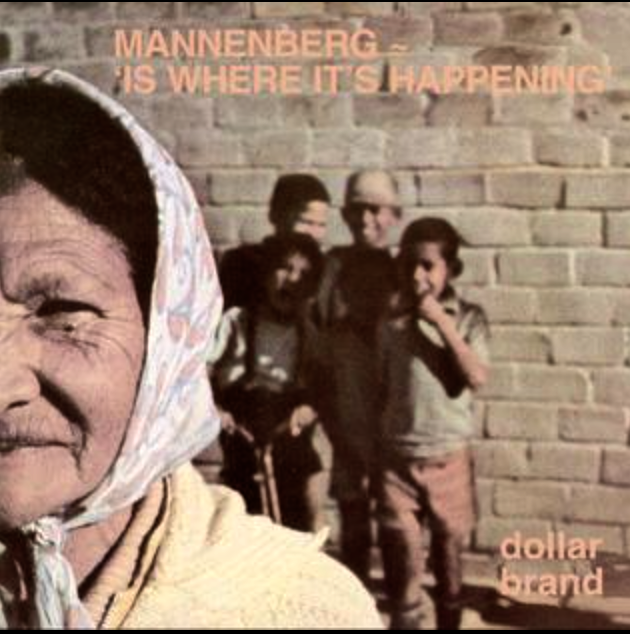
More importantly, the tune Mannenberg became something of a national anthem in terms of the Struggle against apartheid. That only happened in the mid-80s though. Every activist event, in Cape Town at least, fired up the crowd when Basil Coetzee and Robbie Jansen broke out their saxes to play it.
Given the status of Mannenberg in the Struggle, it would be quite appropriate to document in some small manner, the making of this seminal tune to acknowledge its place in history.
Apart from the musicians, the only other people in the studio that day were Rashid Vally who ran a record shop in Jo’burg and financed the occasion, recording engineer Vic Versveldt and Paddy Lee-Thorp who put together a national Dollar Brand Tour and managed and recorded Jonathan Butler, Zane Adams and Pacific Express.
Sadly, all in the studio that day have passed on, bar Morris and Paddy. They are the only persons left who were privy to one of the most important music compositions of our time.
So, how did the day pan out? Did they come prepared, all knowing their parts and do 10 takes of the tune before they got it right? What will history show?
In an interview decades after it was recorded, Abdullah said: “When we recorded this song, Mannenberg, when it came, we just played, we just played.”
It was a “one-take wonder”. That is borne out by Morris and Paddy.
Abdullah said of the day’s recording plans that he had had a few compositions penned and he intended to rehearse with a “big band” before laying down tracks. He ended up with just three horns.
When it came to laying down the track for Mannenberg, things changed. Abdullah sat at the upright piano that had been modified with thumb tacks to give it that distinctive sound and began playing to give the others an idea of where he was going with it. About 10sec in Paul picks up the mood on his bass and 15sec, Monty picks up the rhythm on the drums. About half a minute later, the horns chime in, led by Basil’s searing tenor sax.
“Julle kan maa’ New York toe gaan, ons bly innie Manenberg.”
[The only vocal bit on the Mannenberg LP, but it says it all]
There was no real rehearsal, no full try out. They just went. It just happened
Morris Goldberg, who was a fixture on the Cape Town jazz scene in the early days but had moved to New York in 1961, pretty much confirms how it all happened.
He had been visiting family and, coincidentally, Abdullah was also back home with wife Sathima.
“We met at some point and he asked me to come to the session,” Morris recalled. “I brought my sax and clarinet. There were no music notes written. He taught us parts singing them to us. Robbie, Basil and I we learnt the parts he wanted us to play by rote.
“At some point, he went over to the piano that we all heard about with the drawing pins in and we started playing. We learnt the melody, a simple melody. We just started playing it, there was not much preparation at all. There was really no prep for that. I was very familiar with being in the studio. I had recorded some tracks with Mariam Makeba in the early ’60s. That wasn’t a problem for me.
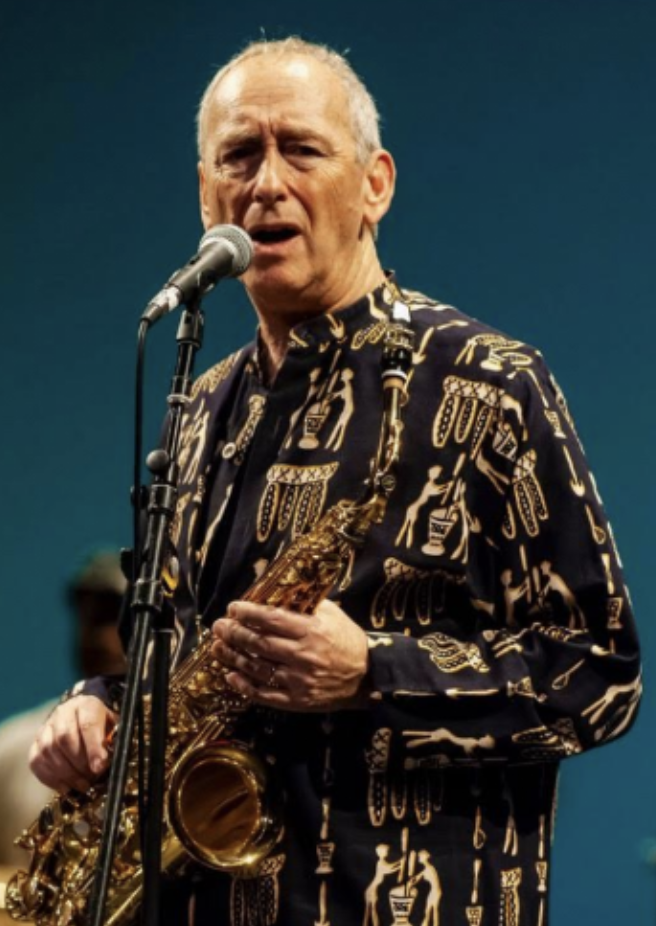
Morris Goldberg . . . played on Mannenberg. Picture supplied
“Of course, growing up in Cape Town, the rhythms were inside of me even though we brought up learning American jazz, the stuff just rolled off. It was second nature . . . that was really the beginning of all of us becoming more aware of our roots and using those rhythms and melodies and sounds that we grew up with.”
Morris admits that he never expected Mannenberg to be so popular. “You never know what is going to take off in terms of records and how successful they are going to be. I was surprised that it got so much traction – and was more surprised when they left my name off the record. Finally, after all these years, it has been put back on. I got a session fee and that was it.”
Interestingly, Morris has never heard nor seen any of the other music they recorded that day “whether he junked it or deleted it or whatever”.
Morris, who turns 90 on October 25, studied at the Manhattan School of Music along with Hugh Masekela and Jonas Gwanga.
“I lived with Hugh and Jonas for the first five months. I don’t remember the time period but at some point, I met Abdullah and I started to play him,” Morris said. “I played with him for a few years and then I didn’t. He went back to CT.”
In an indirect way, Morris also had something to do with the cover photograph of the woman on the cover. After they did the recording, Abdullah visited Morris where he was staying with his sister and enquired after Mrs Gladys Williams who worked for the Goldbergs.
“He found her right there and took her photograph at some point, I wasn’t present for that and he put it on the album.” Abdullah fancied himself as a bit of a photographer.
The name of the album, it is said, is linked to the fact that Basil Coetzee had been one of the apartheid government’s forced removals from District 6 to Manenberg (which is the correct spelling). Mrs Williams, it is believed, also lived in Manenberg.
Paddy Lee Thorp says he has vague memories of Morris or Monty inviting him to the session but he had a connection Abdullah because he was the promoter of Abdullah’s SA tour.
“During that tour I heard Cape Jazz for the first time or shall I say it dawned on me that I was hearing something distinctly Cape in the jazz that the group played,” Paddy says.
“I arrived when they were setting up and heard Dollar play the doctored piano in the hallway. I don’t think I stayed all day. But I was there for Mannenberg and a couple of other tracks.
“It was a one-take wonder, very little rehearsing if I remember. On Mannenberg I was actually in the recording room with the musos, sitting in the corner. Dollar was tinkling on the doctored piano in the studio by this time and the engineer said, ‘let’s do a take’, I think so I just stayed in the room – silently.”
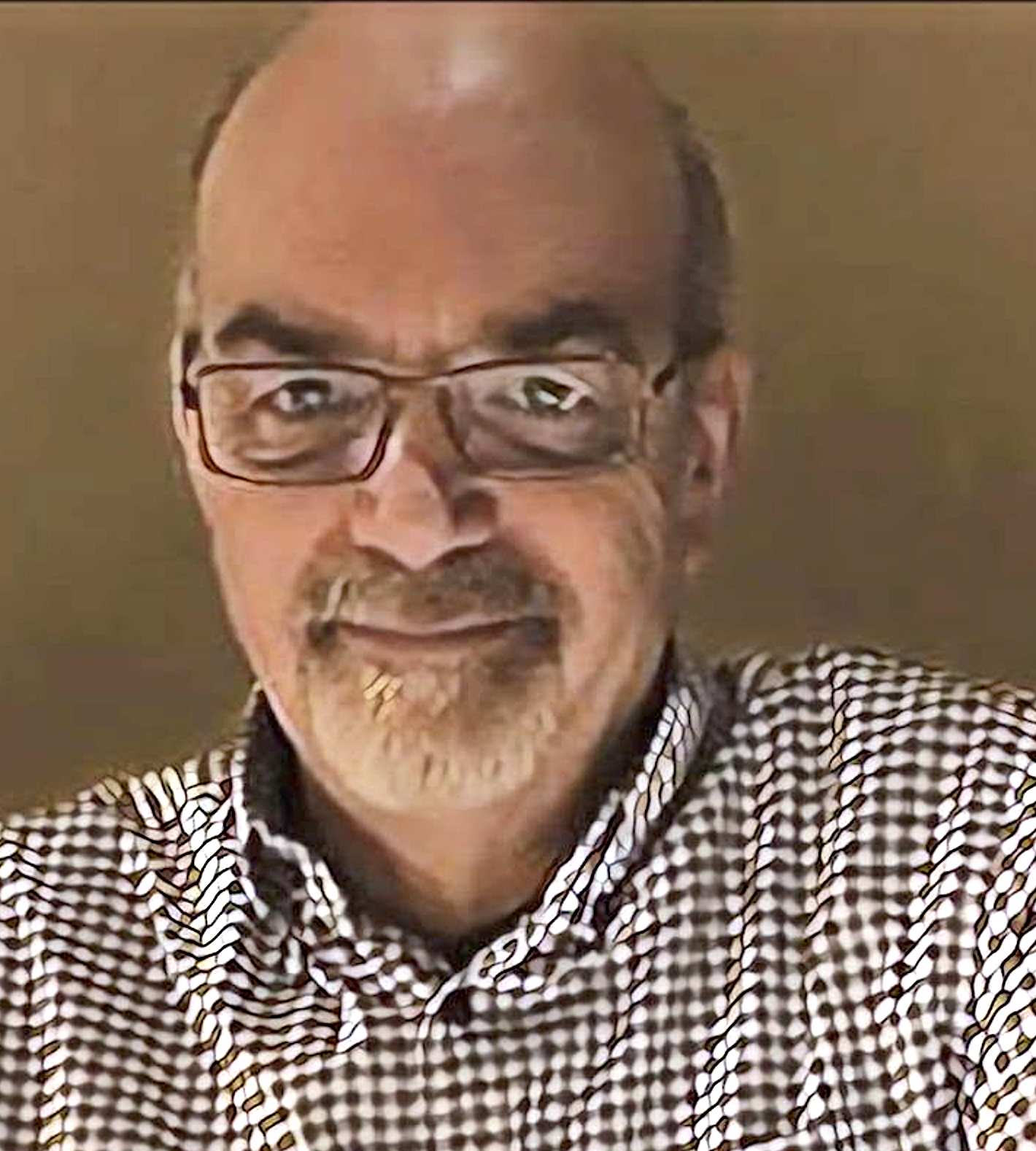
Paddy Lee-Thorp . . . a witness to history.
Apart from managing and producing artists, Paddy also ran Mountain Records with Jonathan Butler, Zane Adams and Pacific Express under his wing. He has no doubts that Mannenberg was a huge seller but says it was very hard to get close to the number of sales.
“I have heard that Rashid on his own sold 5000 from his shop alone. I believe the album went double platinum in SA which is 140,000 units. I have heard half a million albums thrown around but am sceptical, It was an EP not LP. So, on the music for money side, it was relatively expensive. I think there was a lot of piracy at the time in SA as well, so a million jazz fans could have had a copy – at least on cassette.”
One of the issues Abdullah had with Mannenberg was that a story was doing the rounds in Jo’burg that Abdullah had copied someone else’s tune. “He took Mannenberg off the market,” Paddy says. “He was accused of ‘borrowing’ the melody from a Joburg jazzman, and he did not need the hassle.”
Data on Spotify shows Mannenberg has been streamed more than 150,000 times
Paddy has gained access to the original recording and is currently involved with a project that will see the composition back on streaming platforms with part of the proceeds going towards setting up a music education project in Manenberg.
Mannenberg has earned its place in South African history on many levels. It marked the time when ghoema, Cape jazz, jiet, marabi – call it what you will – came out of its box and said, ‘it’s our genre, we should be proud, it belongs”. And in terms of its place in the Struggle, it may well be right to call it the second national anthem.
Related material
Basil ‘Manenberg’ Coetzee . . . a prophet way before his time
Abdullah Ibrahim/Dollar Brand . . . irascible, cantankerous but a ‘genius’ to his peers

