

[Click on images to enlarge]
16 June 2026
Today, June 16, marks the 50th anniversary of the day the student body of black South Africa sparked the fire that lit the fuse for civil disobedience and protest across the country. Mass demonstrations. Police confrontations. Burning buildings. Schoolchildren died.
Many schoolchildren died. Thousands lost their lives over the next decade or so as the fire in the belly of the Struggle took hold and flickered and flared intermittently keeping the bastardry of the white regime in the glare of the world spotlight. It helped to end the brutal rule of apartheid.
The Struggle did not start on June 16. It started many years before. But June 16 marks the day the schoolchildren said: “We’ll lead the way. We’ll give voice to the Struggle. We’ll take up the cudgels while our leaders languish in jail.”
In the days and weeks before June 16, discontent in black schools had been simmering because of opposition to Afrikaans – the language of the oppressor – being forced as a teaching medium in township classes.
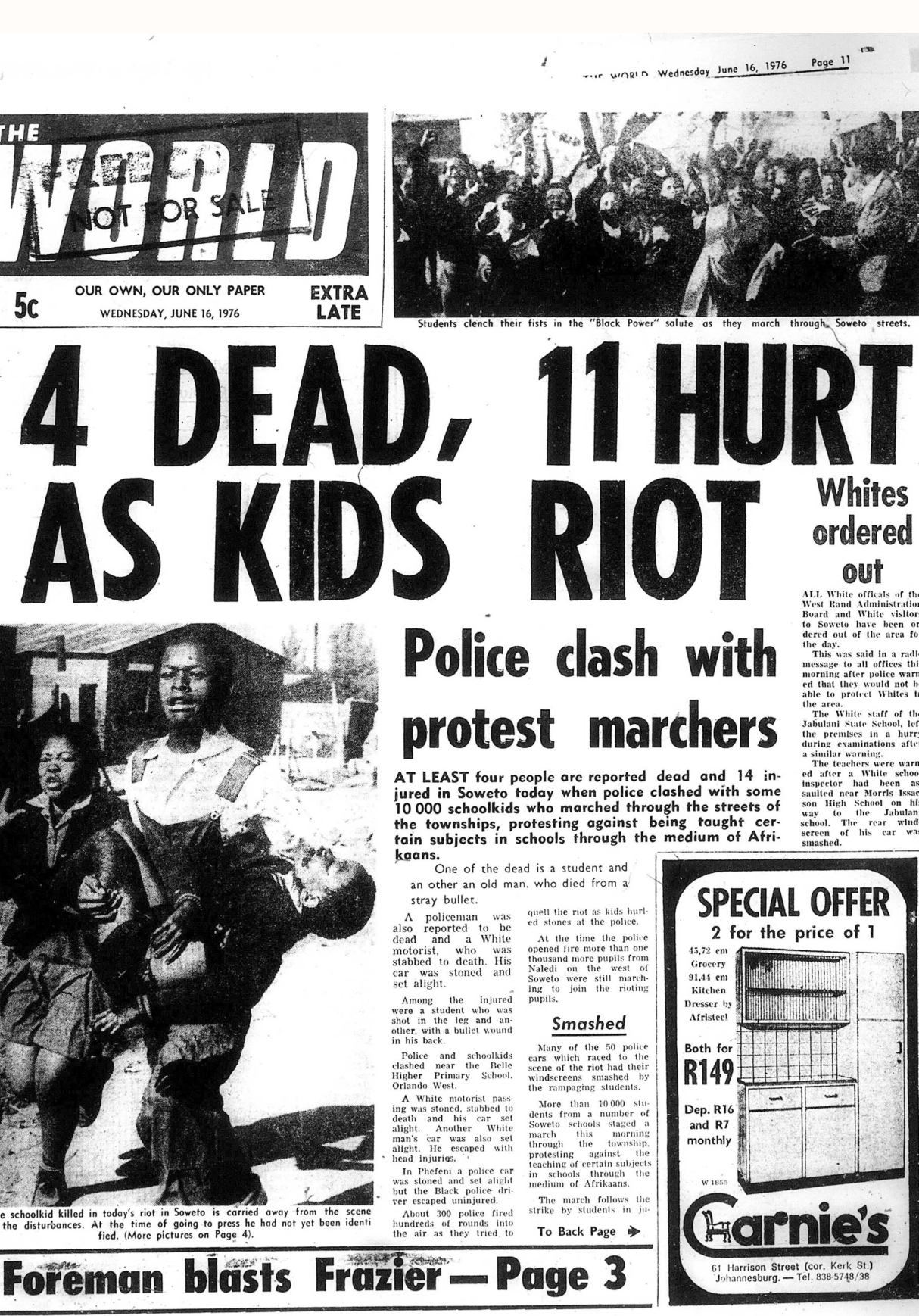
On a nondescript winter’s day in Soweto – cold and brisk – it all came to a head as police opened fire on defenceless schoolchildren. Many died. Sixteen-year-old Hector Pietersen was one of them. His limp, lifeless body carried on front pages around the world. The townships around Johannesburg were in flames. Burning tyres, burning buildings, burning passions.
Yet, white South Africa went about its business, their lives untouched.


Slowly, the embers of those fires drifted across the country and the protests in schools grew. The front page of the late edition of The World newspaper on June 16 recorded in stark language FOUR DEAD, 11 HURT AS KIDS RIOT. URT Hurt As KIDS RIOT HHHH
Worse was still to come.
The front page of the Cape Herald, the weekly newspaper for which I worked, did a wrap up of the situation in Soweto in its Monday edition following Wednesday June 16, 1976. It had a front-page headline that read: The Winter Of . . . OUR DISCONTENT. It detailed some of the unrest in Soweto and other townships in the Witwatersrand area. It also had a smaller story about what was happening elsewhere. Alongside Cape Town and Port Elizabeth it stated simply: All quiet.
Life on the Cape Flats carried on as pretty much normal (bar the fact people were living under apartheid – not normal). Isolated incidents like the principal’s office being burnt down at Hlangisi Primary in Nyanga and fires at the Langa Post Office and Zimosa School were the only hints of things to come. This all happened before the end of June ’76.
For the next few weeks people went about their business as usual but there were signs that what was continuing in Soweto was attracting more attention in some quarters. On 2 August students at the University of the Western Cape (UWC) met to declare solidarity with Soweto students and started to boycott classes. Four days later there was a protest in solidarity with the UWC students.
In the ensuing weeks, there were more protests and demonstrations and more property damage at a number of schools including:
-
August 11 – Students in Langa, Gugulethu and Nyanga marched in solidarity with the Soweto students while student leaders at UWC and community leaders were arrested;
-
August 12 – Ongoing confrontation in Langa and Gugulethu resulted in extensive damage and local residents stopped people from going to work. UCT students marched stopped in a march on the City, while police and students clashed at Bellville Training College.
-
16 August – The boycott of classes spreads to Belgravia High and Alexander Sinton. Elsewhere a few hundred UWC head to the Bellville Magistrate’s Court in support of the 15 fellow students facing charges.
-
August 23 – Athlone High student body issues a strongly worded statement condemning police brutality, inferior education, segregation laws and the plight of the detainees. Police start entering schools to confront the schoolchildren.
-
August 30 – Hundreds of students from a number of high schools march to Bonteheuwel for a mass meeting. They are blocked by a strong contingent of riot police who use teargas to disperse them.
-
September 1 – More than 2000 Langa, Nyanga and Gugulethu students march peacefully through the Cape Town CBD unhindered. It is the first major protest activity in the city centre.
-
September 2 – More students gather en masse in the city intending to march peacefully again. Police intervene and fire tear gas at the students affects. Workers in the city get a taste of what is happening in the townships as chaos reigns in the CBD.


There were much much more confrontations and the Cape Herald tried its best to cover as much as they could to make sure the community was aware of battles raging on their streets. It was tough because the paper only came out weekly. In the townships not many people received their news from The Argus or Cape Times.
Some of the Herald’s headlines over those intensive weeks following June 16 read: Pupil Power, They Said It Could Never Happen, Black September. Initially we, like other newspapers, said the students were rioting. Students told us quite emphatically, they were not rioting, they were protesting and it was civil unrest.
The Struggle was shifting to another gear and the schoolkids were in the vanguard. They paid a heavy price, Many died. But, more than ever, South Africa and its brutal regime was in the world spotlight. The international media, through nightly news bulletins made sure it was on the TV screens.
In an almost perverse way, the advent of TV had unintended consequences for the ruling government whose ultra-conservatives fought long and hard to bar the “evil box”. They lost the argument and in May 1976, TV hit the screens in South Africa.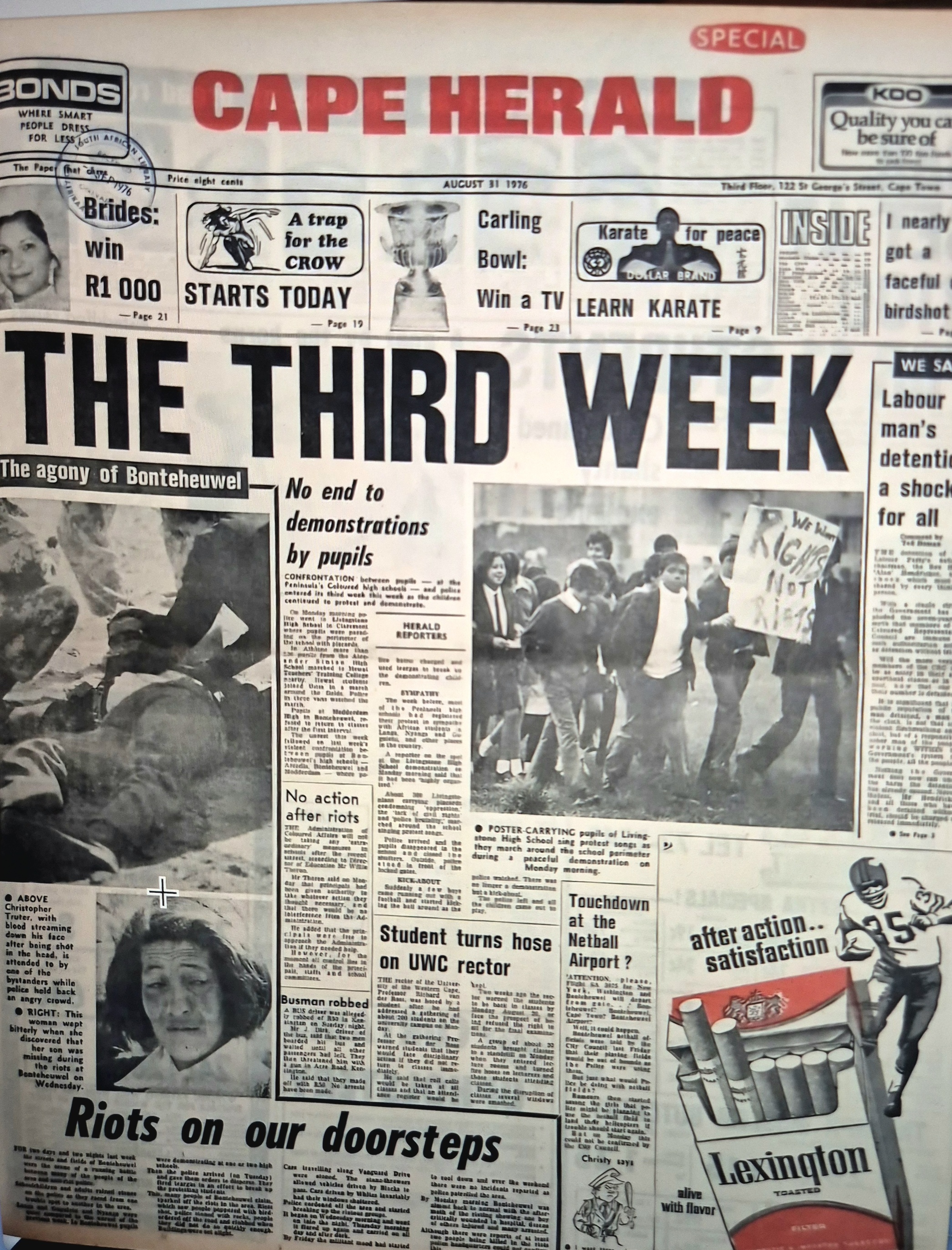
A month later, South Africa could see what the world was seeing on their screens – students marching, police reacting, community reaction. Admittedly, as was their wont, the government-controlled SABC slanted the news to suit their narrative. But white South Africa sat down to dinner nightly to see the black areas ablaze. As it turned out, contrary to Gil Scott-Heron’s protest song of 1971, The Revolution Will Not Be Televised, the student uprising that started on 16 June 1976, was on the TV.
The schoolchildren and university students who led the protests are now in their 60s, nearing 70. For them, the Gen Xers, it was a lived experience. Millennials (GenY) and Gen Z should be more than mindful of the significance of June 16.
In the weeks before the June 16, 1976, the populace, the lives of those on the Cape Flats in particular, was pretty humdrum. At night, on the TV after a hard day’s work, people were watching The World At War (who knew). Live performances of Joseph and his Amazing Technicolour Dreamcoat was doing the rounds, Drag artists Terry Fortune was entertaining the main attraction at The Sherwood in Manenberg, and Bloodshed was playing at the Rock Den!! If you wanted to catch a movie, White Fang and Hombre was on at the Funlands Drive In; Chuck Norris and Bruce Lee were starring in The Way of the Dragon at The Gem. And Steve McQueen and Charles Bronson starred in The Valachi Papers at “The Oubaas” (the Athlone Cinema).
A slice of life as we reflect on events around 16 June, 50 years ago . . . aluta continua!
[Editor’s note: All images sourced from archives]
[No AI used in the compilation of this article]


Thanks for this. I was there when Bellville Training College was attacked by a militarised police force.
LikeLike