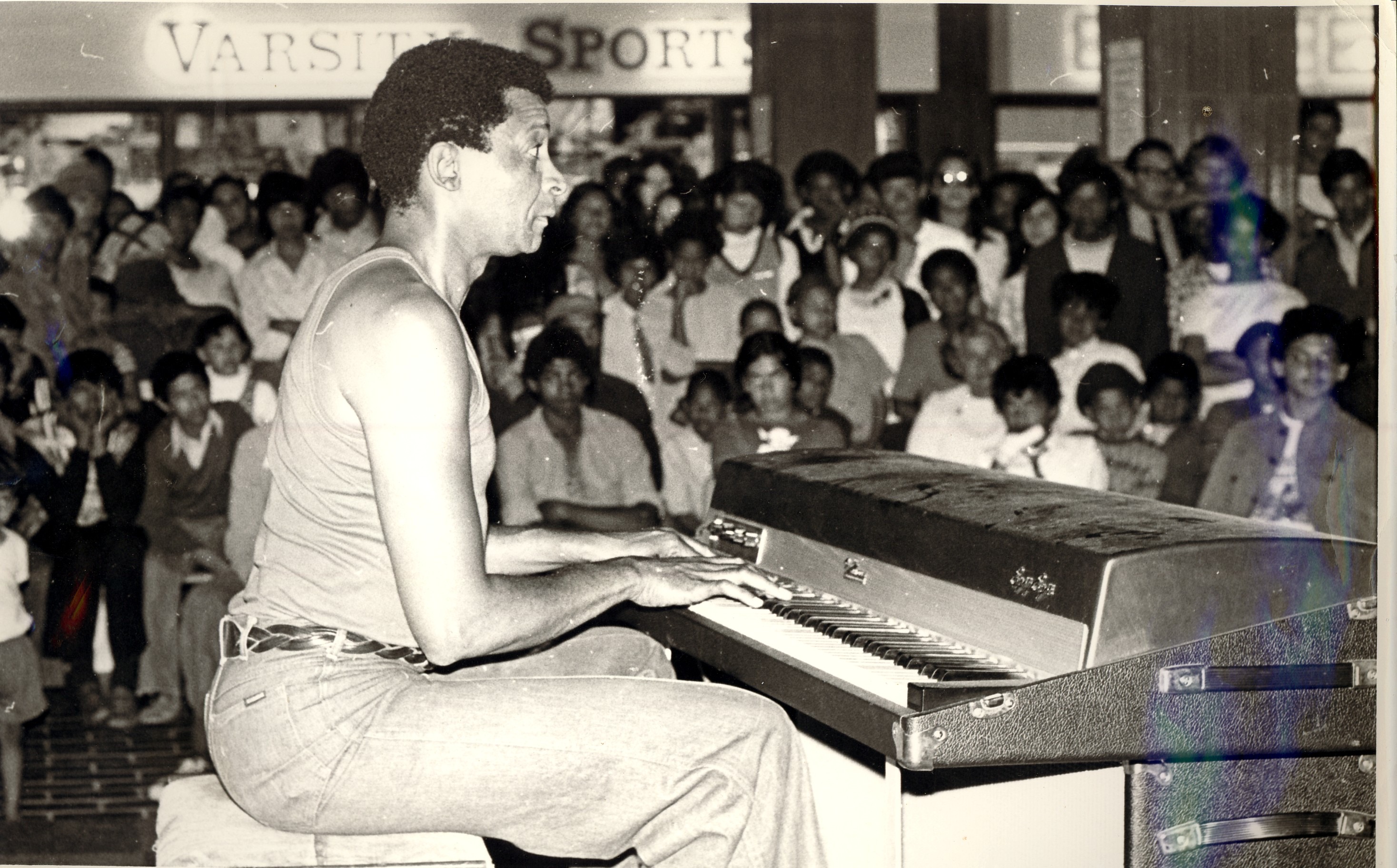
Abdullah Ibrahim captivating a young student audience back in the Seventies.
Much has been written about the passing of Abdullah Ibrahim – Dollar Brand to those who knew him back in the day – and rightly so. The multi-instrumentalist jazz musician was a giant on the South African music scene and well-respected internationally.
All across Europe to the jazz hotspots in the US, to sold-out gigs in Australia and Asia Abdullah Ibrahim did us proud with his innovative music, initially steeped in mainstream jazz and then, going back to his roots, playing sounds that reflected his place in Africa and more specifically Cape Town.
After almost 70 years as a stage performer and a prolific 50-plus albums released during that time – including the seminal Mannenberg Is Where It’s Happening in ’74 – there isn’t much left to be said about the music of this talented son of the Cape Flats.
Yet, I’d posit, not many today would know much of Abdullah Ibrahim, the free yet complex spirit of the ’50s and ’60s who, while his talent was already acknowledged, saw his stocks soar when the America jazz giant of the time, Duke Ellington, lent his name to the album, Duke Ellington Presents the Dollar Brand Trio. The Dollar Brand of then was quite different to the Abdullah Ibrahim after his epiphany and conversion to Islam in the ’70s.
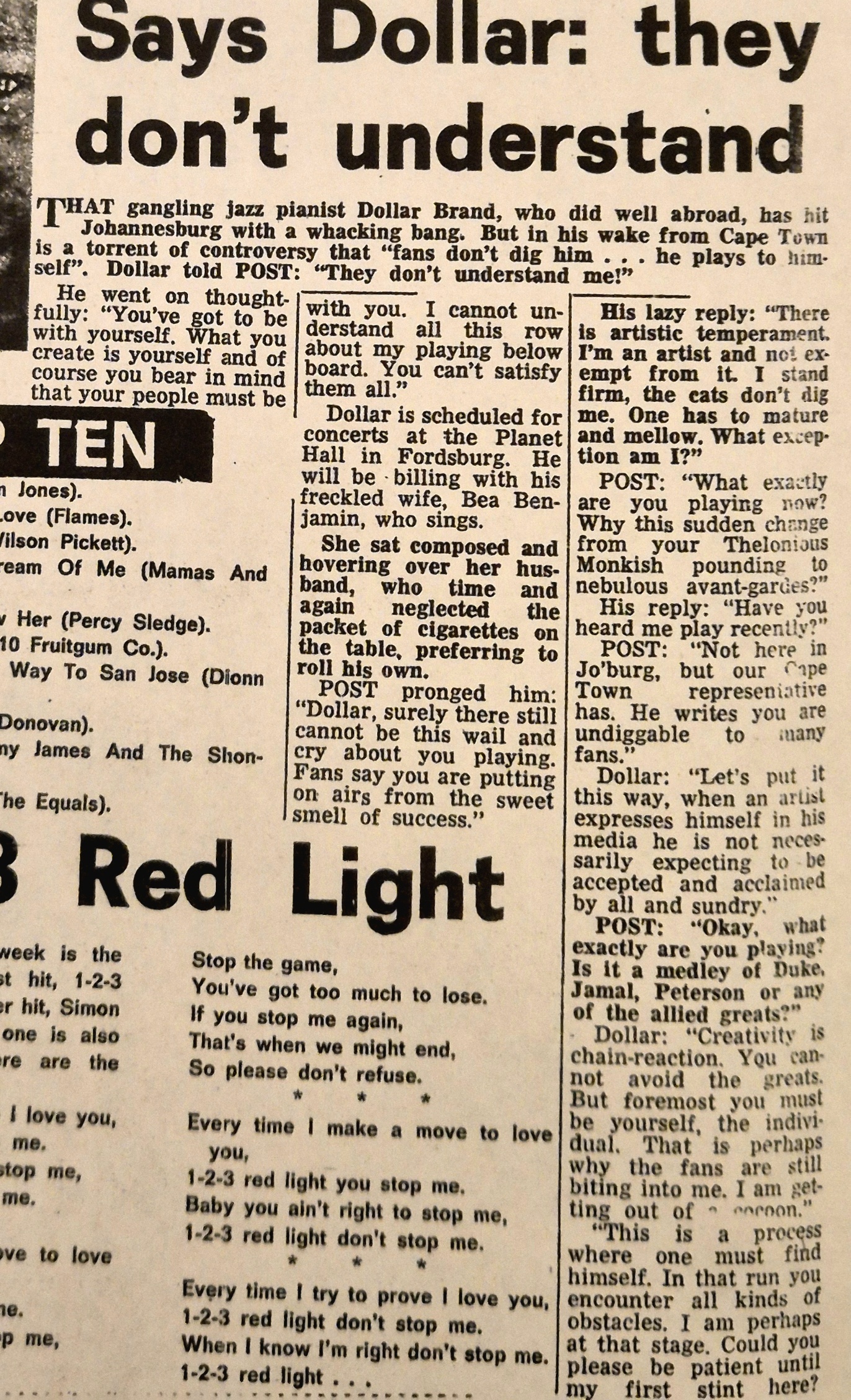
The talent was still there in abundance and he was much more focussed on a healthy lifestyle. But he was a lot less cantankerous and irascible. Nothing like the early days when it was not unusual, almost expected, for him to do something at gigs that set tongues wagging. Most times people just did not understand his progressive jazz sound. 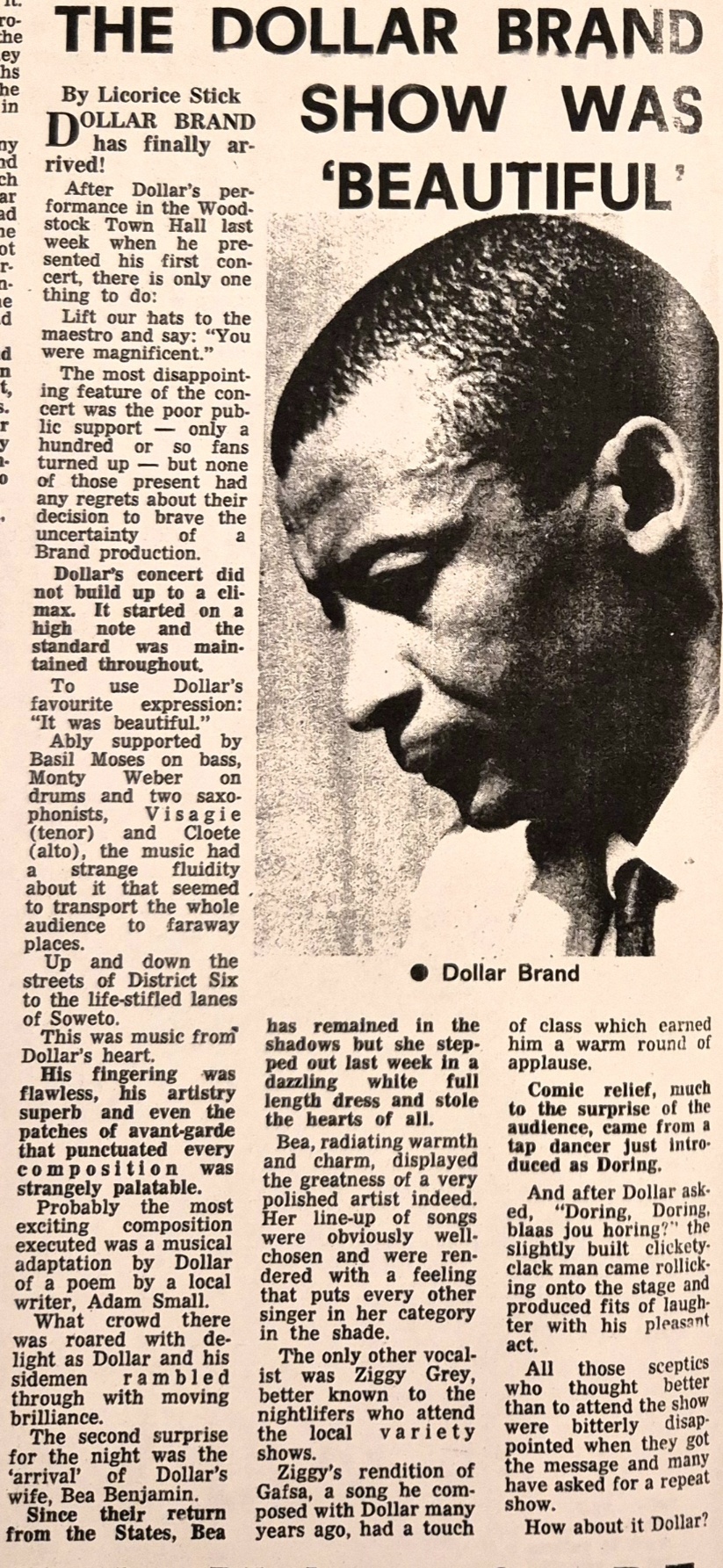
Most of Abdullah Ibrahim’s peer group of the ’60s and ’70s have long since departed this mortal coil but some of their views on Abdullah can be found in the Cape Town jazz book compiled by Lars Rasmussen and bears retelling to give an insight into an at times, flawed genius.
Drummer George Cupido who played with Dollar in the ’60s at the popular clubs in District 6 around then (the Naaz, the Zambezi and Ambassadors] recalled in the book the time when Dollar stood them up: “One night Dollar was the feature artist at the Naaz. It was a big night. I played in the opening set. At the break, I went outside and Dollar called me over to a car. He wanted to know what was happening inside. I told him there were few jazz fans, the rest regular patrons. He said, ‘see you’ and drove off. Imagine people dancing The Twist style to Abdullah’s music. How disgusting.” Cupido described him as “the master musician of all of us”.
“At jazz concerts he would arrive late, appear on stage dressed in a overalls, play solo, then utter a few grunts and groans, indicating the tempo he wanted and we would accompany him. These sessions were acknowledged as great performances.”
Trumpeter Banzi Bangani, a band leader in Langa the ‘’50s, when asked how Dollar Brand was as a young man, his response was: “Dollar? Very temperamental! If you had no way to handle him, he would just walk away. You must have a way to handle him. Very short-tempered. But nice, very, very nice.”
Jazz singer Zelda Benjamin, in her interview with Rasmussen, said she sang with Dollar just once at the Goldfinger in Athlone. “I could not stand what he was playing because he was into this whole [jazz pianist] Thelonious Monk trip but making it sound worse than Thelonious at his worst. I mean. It was terrible. This was not the Dollar we knew and who I used to go and listen to every Sunday evening. Guitarist Cliffie Moses and I had a helluva argument about it because he could not understand why I could not appreciate it.”
Bassist Sammy Maritz said in the book Dollar was influenced greatly by Thelonius Monk, “so much so that when he played it, nobody understood it”.
“Everything started with Dollar. He was one hell of a guy. One fantastic guy. We fell out a lot, we quarrelled lot, but he was 10, 15 years ahead of his time. I must say with sincerity, was it not for Dollar, a lot of musicians wouldn’t be what they are now. It didn’t matter how little you had in you, Dollar could take you by the hand and lead you further on.”
 Langa trumpeter Duke Ngcukana recalled rehearsing with Abdullah to play a couple of concerts in the ’70s. “Dollar was that person,” he said. “We rehearsed for days and days. Come the concert, the first set, the first half was completely different. Second half was the familiar stuff. Then we did another gig and he wasn’t there. We played our own music. He came in at the end of the show very angry and asked, ‘what shit is this, why aren’t you playing my music’. I said, ‘but you’re not here’. His response was ‘what do you mean I’m not here, my spirit is here’.”
One of the few people still with us who played with Abdullah Ibrahim in the early days, is drummer Brian Abrahams. At 78, Brian still leads a group called Afrospace Interchange in Melbourne and they wow the crowds with their mbaqanga sounds. Brian toured with Abdullah in Europe and the US off and on for three years, He was also the drummer when Abdullah recorded African River in New York.
“I met him in Swaziland in the ’70s when he lived there and I worked there,” Brian said. “We met in London a few years later when we played one of his support concerts. Not long after he invited me to go on a tour with him.
“He was a hard taskmaster. Also, a genius. But he taught me how to really focus on the essence of the music. He had his moods, sometimes not speaking to us for days. Other times, he would be very jovial and keep us up till three in the morning talking bollocks. And then, for the next few days, not speak us except shout ‘assalaamwalakum’ and sit at the piano and play a few notes until he has our attention. That was just his way of him just drawing us into his music.
“I say that because I toured with the man and I understand what made his music so special for so many people on this planet. I won’t say he was self-centred; he was eccentric. He was into what the music was about and very little else was important.
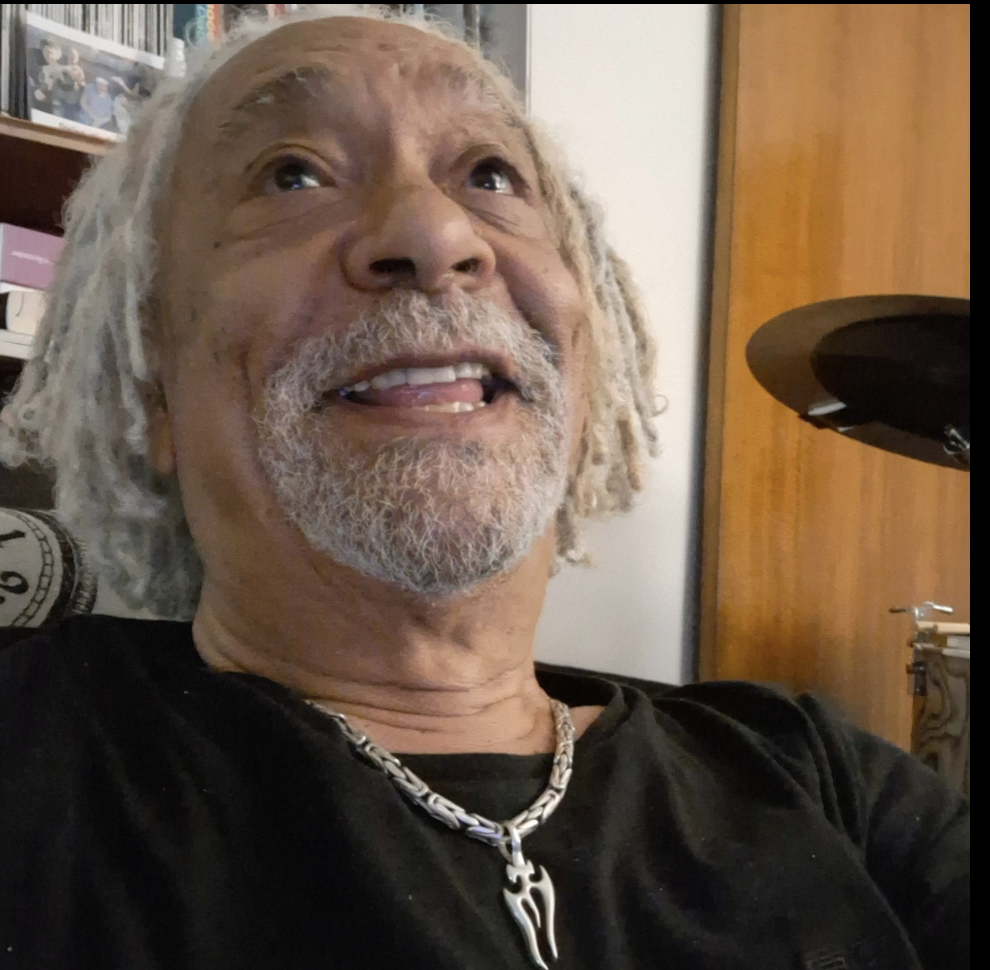
Drummer Brian Abrahams . . . toured with Ibrahim.
“He was very temperamental. He once pushed a piano off stage at a gig and went home. In Amsterdam, we did a set and the people loved it and screamed for more. There were thousands of people and they roared for him to come back and take a bow. He just walked off, got onto one of those bikes that you get all over Amsterdam and rode off into the sunset. Back at the hotel I said to him that the people wanted him back on stage for an encore and his response . . . ‘they can come back tomorrow’.
I met Dollar in the late ‘60s, as a young journalist covering the music beat in Cape Town. He wandered in and out of the newsroom often, looking for publicity for his gigs. Most times he was quite chatty in a serious way. I had heard enough about him to know that he was a bit . . . different. One day as I walked out of The Post building in District 6, he was slumped in the doorway, well out of it. He grunted a greeting and I moved on. A few days later he passed me in Hanover St – and looked right through me without a hint of recognition.
He made up for it years later though when he showed his appreciation for some write up I did. He left me a not which read: “To Warren, the Chosen One . . . Dollar”. I’m not sure what happened to it even though I am a hoarder.
Fun fact: people often wander where he got the name Dollar from. A Jo’burg scribe claims to have given it to him because of his love for American music. My money is on the fact that he was born Adolf Brand in Kensington and everyone knows that if you were born Adolf on the Cape Flats, you are almost for sure and certain going to be called “Dolla”.
Hoping you’re playing some cool jazz with a Cape flavour in the hereafter Dollar/Abdullah.


