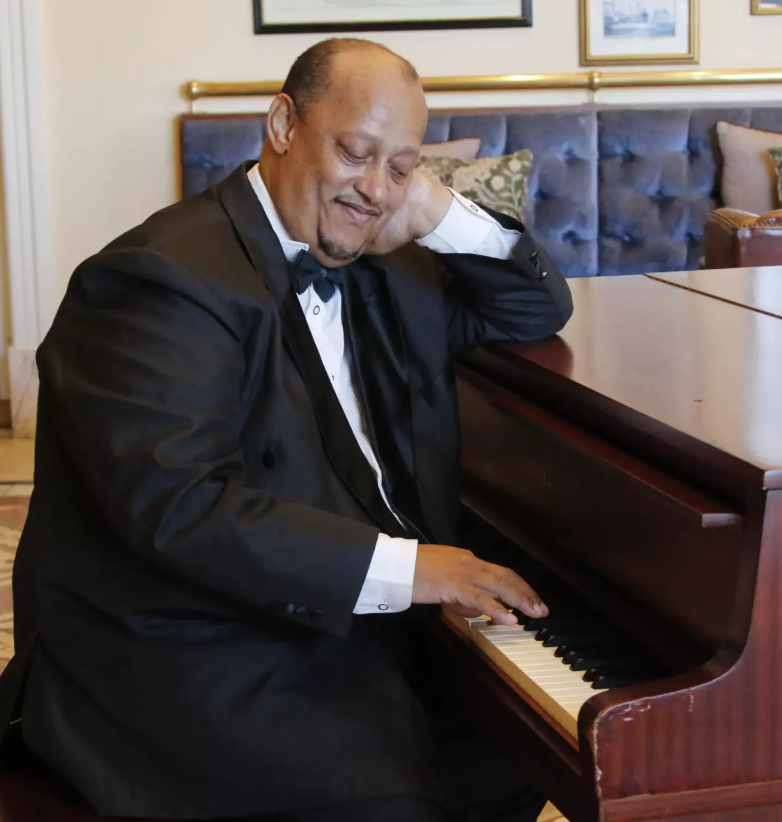
Onyx Phillips . . . in his comfort zone when he is anywhere near a keyboard.
26 October 2024
Onyx Phillips, veteran pianist with more than 50 years of tickling the keyboards, has entertained people from Athlone to the Comoros, to the Arab Gulf states, Europe and the UK. One can say, with justification, he has name recognition.
Yet somehow, even if he had not been playing all over the world, there would still have been name recognition. Onyx – a solid black gemstone sometimes layered with white.
He is quite keen to tell you his name is pretty unique: “As far as I know, I’m the only Onyx in the country and there are only about 160 of us in the world.”
It is not unknown for parents to name their babies after gemstones . . . Ruby, Amber, Pearl, Jade. Onyx is next level. There is, however, a biblical connection for the strongly religious family. The name is a nod to the layered stone foundations of the Holy City.

Early days with Sapphyre … from left, Onyx Phillips, Paul Petersen, Madeegha Anders, Taliep Petersen and Issy Ariefdien.
There is another feature of the Onyx make-up that sort of sets him apart from the crowd. He can say, truthfully, he was born on the island of St Helena where, according to “folklore on the Cape Flats” many families had their roots as they denied their indigenous South African heritage.
“My parents were originally from Tsolo in the Eastern Cape,” Onyx says. “My father had Xhosa and Scottish roots and my mother Khoisan and Dutch. Onyx was born on the island of St Helena. My father, as a preacher, was sent to St Helena where my sister Phoebe and I were born.” He has another sister, Emerald, and a brother, Orion, named after the constellation people of faith regard as the gateway to heaven.
In 1962, age two, Onyx’s family returned to South Africa and settled in Athlone. Onyx attended Sinton Primary, Athlone North and Belgravia High. At home and at school he was already showing an aptitude for music.
“I had a fixation with music from the age of 7 or 8. My father played accordion and piano; my mother loves to sing. They were church people. I was influenced by that,” Onyx says. “Also, there were about six families in the street with pianos.”
A teacher living in the road had a connection with the Trinity College Music School and Onyx started learning practical and theory with her.
“As a reader, I learnt to play different levels of music. I loved Mozart, Mendelsohn, Bach, Chopin. At the age of 8 and 9 I was reading most of their books in the libraries, discovering their genius. I was the church’s organist at 13 until I was about 21.
“Music has been my life, close to 50 years. I have been eternally grateful and reaped huge benefits. It has been absolutely countless hours of joy and meeting people.”
Although Onyx’s early music education was based in the classics, he yearned to broaden his skills as his appetite for other music styles developed. He was listening to the music of George Benson, Al Jarreau, Chicago, and Earth Wind & Fire.
“I am classically trained and then I went for musical lessons Mertin Barrow to learn to play jazz,” Onyx says. “I went from classics to pop at the age of 18.”
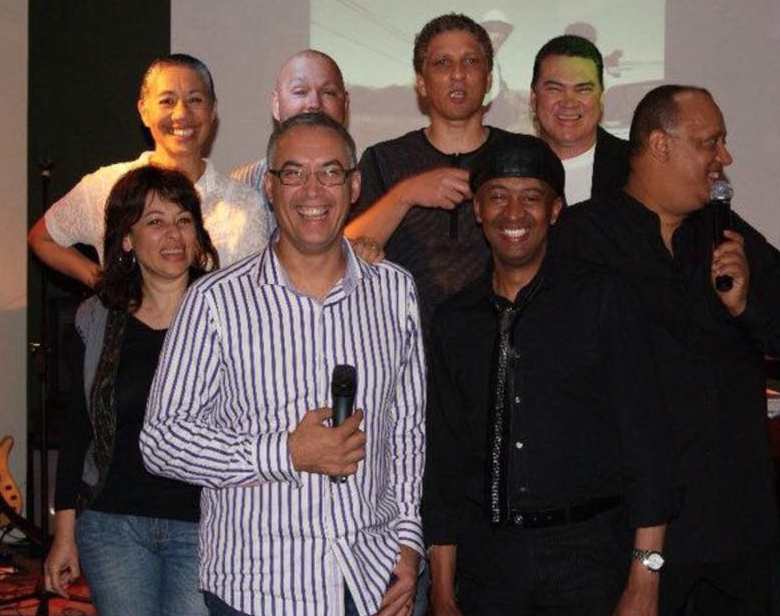
Onyx Phillips, far right, with the older version of Stitch, the first band he played in with Glenn and Michelle Robertson, Mark Bezuidenhout and Tina Schouw.
His first go at playing in a band was with Glenn Robertson, his wife, Michelle, Mark Bezuidenhout (now living in Australia) and Tina Schouw. “I got a call from Paul Petersen that led to my first my first real paying gig at the Eureka Lounge in Elsies River. The band was called Dr Rhythm and included Robbie Jansen, Qader Khan, Warwick Hawkins and Ian Herman on drums.”
As was common with bands around that time, the outfit did not last long, and Onyx found himself with Jackie and then Jie Jah Jungle and other bands which generally eschewed the pop sound and leaned to the jazz fusion genre.
Onyx doesn’t entirely reject the “jazz pianist” tag. “People call me a jazz pianist, but I play anything . . . Richard Clayderman, Mozart, Fleur de Lis!! Anything to do with key boards, I play anything.
“I was the church organist at the start, I played gospel music in the Seventh Day Adventist Church. Then mostly the pop stuff followed by fusion. I loved listening to Corea, Hancock and Ramsey Lewis who is up there with Henry February, my mentor. I do enjoy playing jazz standards. I do well at it, I know I do well at it. No ego. I love playing classics but I’m also not a snob or any type of genre.”
The music bug was beginning to bite big time in Onyx’s life but, after matriculating at Belgravia, he had to deal with his father’s view of the world that related to having a stable day job. Which is why he found himself at a desk at Homes Trust Life.
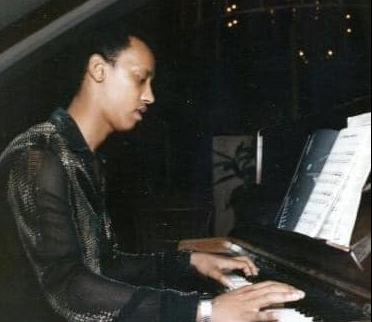
Onyx Phillips, the young classicist, learning Bach, Beethoven and Mendelsohn.
“I had no idea what I was going to be after the age of 18. I just knew I was into music, and I loved listening to bands like the Four Sounds, Drive, Touch. My father was an insurance broker agent, so that was just a job to get me out of the house instead of sitting around. I also knew that it would pay for my music lessons or get me to see other bands. I had no intentions of being an insurance broker. My dream was to be a fireman when I was a kid, but I knew music was going to be a major force in my life.”
After those early years of gigging in the clubs on the Cape Flats, his career took a step in another direction when he joined Taliep Petersen’s Sapphyre at the Cape Sun in the city. It was the start of associations with the likes of David Kramer, Zane Adams, Alvon Collison, Terry Fortune, and others. The day job fast became a thing of the past as he immersed himself more and more into music.
Overtime, Onyx figures he has played in close to 20 bands, some lasting a few months and others a year or two. He says he had the most fun playing with Just Us during Covid but the most important band was still Sapphyre.
“Sapphyre was the longest and the most intense. We did a lot of work and travelling including a long stint in the Comoros.”
He has accompanied many artists over the years, but his personal favourites remain Zane, Taliep and David. It has also given him a closer insight into working of the Cape Town entertainment scene and South Africa generally. He feels Cape Town artists struggle a bit because the big breaks come if you’re in Jo’burg.
“Cape Town has brilliantly talented performers who don’t really progress to a big stage unless you cross race lines, cross genres or go from local music, sakkie, pop . . . maybe you could sell more. The broader view is Cape Town is very special with jazz and pop. People think that Cape Town is THE place for jazz, but Jo’burg has jazz too.
“It all boils down to what you make of your life, decisions of what you want to do as an artist: do you want to stay in CT and live on a low economic level. Now you can fly to Dubai, Europe, New York. Things have changed. Now the young ones coming through are taught to read contracts. We didn’t have that back in the day.”
Once Onyx realised that music was his day job and night job, he took the step that has stood him in good stead for more than 40 years. He engaged booking agent Maurice Fresco. It led to him playing all over the world but mainly in The Gulf’s top hotels.
“I played and stayed in the best hotels – like the 7-star Emirate’s Palace. I woke up in the morning with a newspaper and slippers at my door and a pool outside my bedroom window. It was a dream life.”
Much of his time playing at these top venues involved performing as a solo artist and, through necessity, he had to sing. He likes to tell people he is a pianist who also sings.
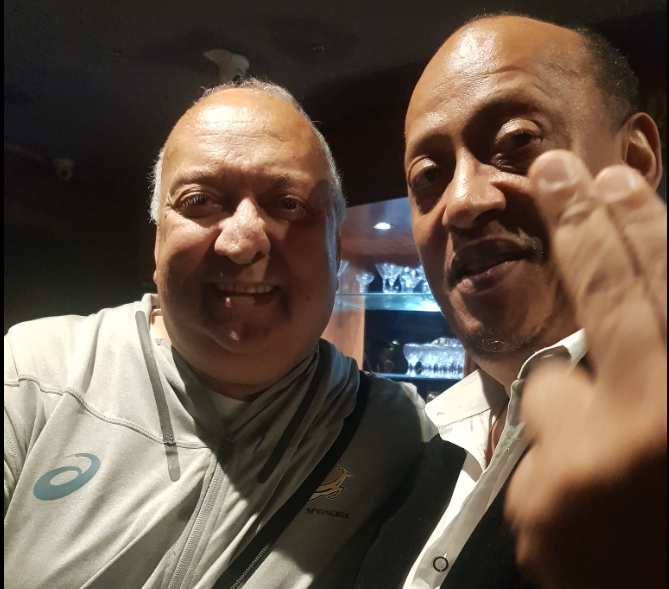
Pianist Frank Cuddumbey and OnyxPhillips. two masters of the ebony and ivory.
“I’m a bit like Nat King Cole who I adore. By default, Nat became a singer. I was left alone once at a gig without a singer, so I had to adapt. I’m a pianist that sings, not a singer that plays piano. Now I like to croon.”
At this stage of his career, from an earning point of view, he feels it is better to be a solo artist: “But I do love to play with a band. Why not? I’m capable of doing it. Playing with Just Us at Swingers was the most fun I’ve had recently. I’m open to things, highly adaptable. One can’t sell oranges only; you must be able to sell apples too.”
Unlike so many of his contemporaries for the ’70s, Onyx has made sure that when he finally pulls down the curtain on his career, he can put his feet up and know he is financially secure. He thanks his parents for that.
“I have endurance and determination in me,” he says. “My parents were motivated and resilient. Post-Covid, I realised if I could play every day and earn a living, that’s what I was going to do. I thought I was done five years ago; I had had my 20 years; I have good nest egg in place with a health plan to keep me healthy. I had all my ducks in a row in how to endure.
“It’s all in your hands. I realised it’s OK if you pay R150 for your funeral, pay it, be consistent. I still pay a policy, I still have medical aid, an investment fund.”
Onyx backs up his financial approach with living a healthy lifestyle. He walks regularly, has a diet of fruit and vegies and adopts things that are good for his mental and physical wellbeing. While he is playing in The Gulf, he still finds time to be the organist in the church on Saturdays.
“Faith is a big thing in my life, I believe the driving force in your life that keeps you away from the darkness and bad habits and bad company, is to be faith based.” But he also steers away from a gospel tag. “I’m not a gospel artist. I am a pianist, I accompany choirs.”
The father of two boys, both university-educated, say he can see himself working for many more years. “That’s what we want from our artists. We want our artists to play further to show the younger generation how it’s done. You have to look after your health. Most of my contemporaries have died and I have learnt from that.”
When he does finally pack it in, he says he would look at his time at the Cape Sun as a golden point in his career citing working with the top artists followed closely by the years in the Comoros where he also got married. He counts helping compose and recording the tracks My Broertjie My Bra and So Long Goodbye for D6 The Musical as another highlight.
Something he’d like to forget? The stint at the Goldfinger nightclub in Athlone in 1981 where they were fired because one of the band members removed the sound system equipment.
 MUSIC LEGENDS OF CAPE TOWN