
Kyle Shepherd . . . a new album, A Dance More Sweetly Played, with his regular trio members, Jonno Sweetman and Shane Cooper, out next week.
15 November 2024
Tomorrow night, in the Baxter Concert Hall, pianist and composer Kyle Shepherd unveils his long-awaited and much vaunted new album, A Dance More Sweetly Played and, in all probability, it is going to be a sell-out. This morning there were fewer than 100 seats left.
Not a bad effort at all. Quite remarkable in fact, given it’s a tad above normal prices and jazz gigs don’t normally get people flocking to the ticket box.
Undoubtedly it is testimony to the high esteem in which Kyle Shepherd and the members of his trio, drummer Jonno Sweetman and double bassist Shane Cooper, is held. They’ve been an item for 16 years, satisfying audiences who prefer a more cerebral contemporary jazz sound.

The new LP from the Kyle Shepherd Trio.
For those who miss out on a Baxter ticket, the album will be available from Monday on digital platforms and – wait for it – as a vinyl LP. The old format, considered dead and buried once CDs and digital came along, actually has a bit of a pulse these last few years and is experiencing something of a comeback among music purists.
Kyle has embraced it and says: “In the last decade or so, a niche market of vinyl listeners has emerged in certain parts of the world. In my opinion, as an antidote to the increasingly digital world. Much like how the Nokia 3210 is making a comeback. So, this new album will be on digital platforms but also on vinyl. For me it was either no physical copies of the album in any form or it would be vinyl.”
The album itself features 12 tracks of which all but two are Kyle’s composition and the title is a nod to his long collaboration as a composer with fellow South African visual artist William Kentridge who created a work called More Sweetly Play The Dance. The two tracks he has covered (and given his own interpretation) are US rock group Journey’s Don’t Stop Believing and UK trip-hip group Massive Attack’s Teardrop. Both are classics in their genre (yeah, I have to confess I had never heard of trip-hop, a mix of acid jazz, post-punk, reggae, and electronica) and even Kyle says it is “something out of character for me” and “a guilty pleasure”.
His choices of the two songs are probably an indication of where his head is at when one tries to pigeonhole him as a jazz pianist. Is this album a mix of the fusions of the African rhythms with the “pure” jazz associated with what comes out of the US and Europe?
“Pure jazz is a loaded statement. I try and think less of what divides music stylistically these days and focus more on what is common between styles. So, on this album we have influences of South African jazz, American jazz, European free jazz, African music and ’90s rock.”
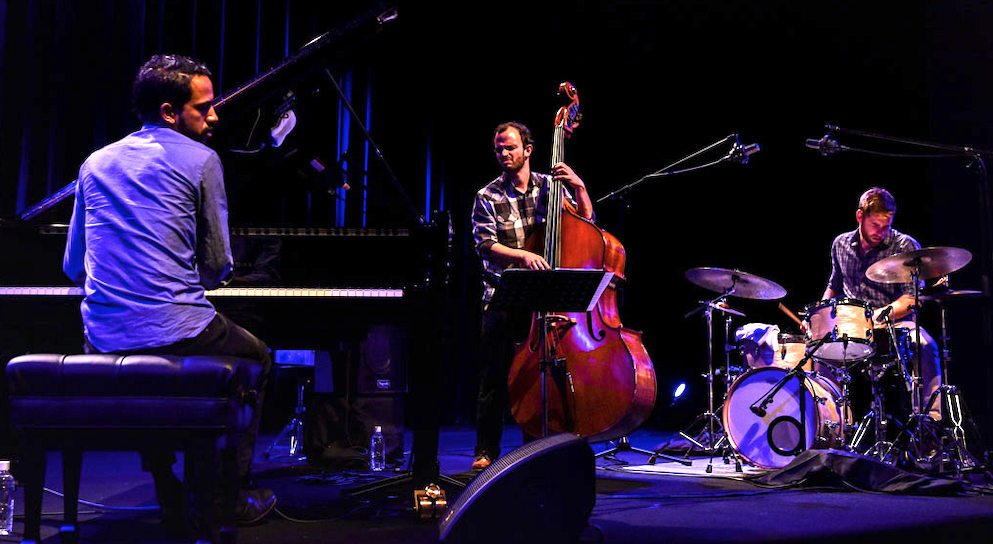
The Kyle Shepherd Trio – Kyle on piano, Shane Cooper on double bass and Jonno Sweetman on drums – immersed in the music they make.. . . immersed he music they make.
The album was recorded back in May and Kyle spent about three months composing the 10 tunes.
“Some of the tunes I had been experimenting with in my studio, discovering which parts of the tunes work or not. Eventually out of 16 tunes we settled on 12.
“With this album I wanted to make a strictly piano trio record. The piano trio has always been an important part of my career and so much I’ve created has been toward playing and exploring within a trio formation. The piano trio for any pianist is vital because you can’t hide behind a horn player or singer in the front playing the melody. In trio the pianist assumes the role of melodist, harmoniser, improviser and more.”
At the age of 37, Kyle Shepherd has already achieved much, much more than most of the veteran musicians who also have their roots on the Cape Flats. He has performed, with his trio, all over the world and written the music scores for films like Noem My Skollie, Barakat and Fiela Se Kind as well as TV series for Netflix. The portfolio of his work is quite extensive. Check it out at https://www.kyleshepherdmusic.com/
Not bad for a “self-taught” musician. That’s not quite true. At a tender age he may have learnt to tickle the ivories whilst being part of a very musical family. But that was followed later in life by studying jazz at UCT and acquiring a masters at Stellenbosch.
“I’ve been around music from the time I was born,” he says. “Even before playing, I learned the appreciation of music from my grandmother, step-grandfather and my mother. The radio in my grandmother’s house was playing classical music all day, every day. My mother is a classical violinist who has also worked with jazz musicians as early as 1990 and went on tour with Abdullah Ibrahim in 1994. Some years later she taught and ran Ibrahim’s music school, M7, in Parliament Street in Cape Town. So, by default, I’ve always been around serious music and musicians. It’s a way of life so to speak.”
For his Masters, he explored his own practice as a composer and improvising player. “It’s important to distinguish that as different to a composer that does not perform and vice versa.”
As the composing element of his skills set became more pronounced Kyle has conditioned himself to strict regimen rather than taking a random approach. “My playing and composing practices are like a muscle that needs constant and rigorous exercise and activation. I get into it by sitting down and doing it every day. The quality of the outcomes varies from day to day but still needs to be done.”
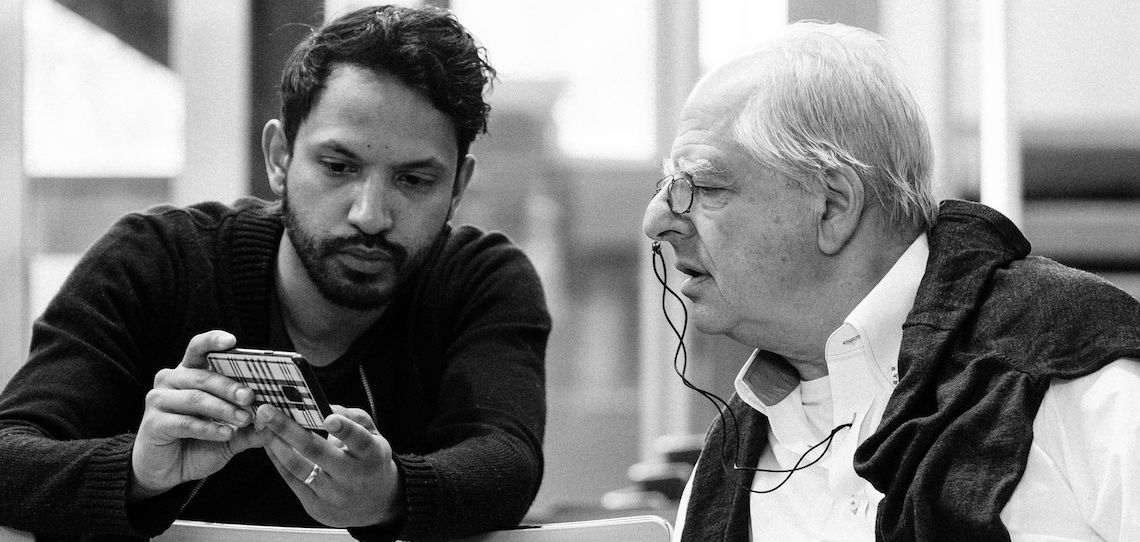
Kyle Shepherd with visual artist William Kentridge with whom he has collaborated on a number of projects.
Kyle numbers quite a few jazz musicians among the people who have shaped his thinking and playing, among them saxman John Coltrane and pianist Keith Jarrett but it is the homegrown Abdullah Ibrahim to whom he owes much.
“Mr Ibrahim has been a mainstay as a source of information and inspiration for many if not all of us young South African pianists. I think of it this way: if you’re born in the USA and want to play jazz you study, before any other, [Duke] Ellington, [Thelonius] Monk, Bud Powell, McCoy Tyner, Herbie Hancock, Kenny Kirkland et al. In South Africa, we are still formalising that lineage into a canon. So, I’m happy that I studied Ibrahim and others as deeply as I did. He is the reason I wanted to play jazz.”
With so many achievements already under his belt, Kyle is pressed to find one that really stands out.
“I have a deep fear that I’ll finally be happy and content with something I’ve done and then – boom –the creativity tap closes. So, I prefer to remain the forever self-critic. But there have been some proud moments. If I had to choose, I’d say I’m very proud of some of the venues I’ve been fortunate enough to play at . . . the Sydney Opera House, Theatre Chatelet in Paris, many halls in Japan . . .”
His one big regret at this stage of his life is not seeking tutelage at a young age. “I developed so many bad technical habits that I’ve since had to undo. When younger musicians ask my advice I say, ‘go get some lessons as soon as possible’!”
A Dance More Sweetly Played came across, for me, as an amalgam of different rhythms, intriguing in places, but easy on the ear on the whole. I taxed him on that hoary old question of ghoema and Cape jazz and whether it is strengthening as a distinct genre.
‘I’m no musicologist. But I will say that I’ve heard a lot of music over the years and while Cape jazz is not 100 per cent unique, it has micro stylistic elements that are unique in the world. Think of how Robbie Jansen bends a note or how Basil Coetzee attacks a note.”
There will no doubt be a fair few disgruntled music lovers who for sure and certain are going to lament not seeing this one-off gig of one of our top performers. Who knows, he may find time for another concert between wrapping up scoring a new Netflix series along with a few others and a major tour to Europe and Asia in 2025.
Otherwise, get the LP for Xmas. I couldn’t think of a better outcome.

Kyle Shepherd, Jonno Sweetman and Shane Cooper . . . playing music from the heart.
All pictures supplied.
 MUSIC LEGENDS OF CAPE TOWN